Research Sourcing
Why Researchers Stopped Ordering Research Materials Overseas. It Was Never About The Price.
The cheap supplier is cheap because of what is missing, not what is included. No registered entity. No address. No lot-matched certificate. No returns policy. Nobody to call. Here is what each of those absences actually costs you.
 Browse the lab-tested range →
Everyone in this category starts the same way. You find a supplier online, the price is good, the site looks fine, and the order arrives.
Then one order does not arrive. Or it arrives and the label does not match what you bought. And you discover, all at once, that there was never anybody at the other end.
No company name on the site. No registered entity, no state of incorporation, no address. There is nothing to write to and nothing to point a card dispute at.
No certificate tied to your batch. There may be a PDF. It describes a product, not a lot. It could have been produced at any time, for any batch, by anyone.
No returns policy, because a returns policy is a commitment. A supplier who has not written one has not made one.
Every one of those is a structural absence. None of them show up on the listing page. All of them show up on the day something goes wrong.
This advertiser is Verse Research LLC, Sacramento, California.
A named entity with a printed address, a published returns policy and a public certificate library.
See who you are actually buying from →1An address is the cheapest trust signal there is, and most sites do not have one
Look at the footer of the last supplier site you bought from. Not the contact form. The footer.
You are looking for a company name, a legal form and a street address. Three lines. Any legitimate operation has them, because it had to register somewhere to take money.
This one prints all three: Verse Research LLC, 1401 21st Street, Suite R, Sacramento, CA 95811. That is not a marketing line. It is an accountability line. It means there is a named legal person on the other side of the transaction.
If the footer has no entity and no address, you are not a customer. You are a transaction.
2Domestic shipping is a logistics decision that becomes a legal one
An international parcel crosses a border. That is the whole risk in one sentence.
It adds a customs step you do not control, a carrier handoff you cannot see, and a timeline nobody will commit to. When a package stops moving, the supplier is in another jurisdiction and the carrier is not the one you paid.
This advertiser ships domestically on FedEx 2Day. One country, one carrier, one tracking number, and a shipping policy written down on the site rather than improvised in an email.
Fewer handoffs is fewer places for your order to disappear with nobody responsible.
3The gate before the catalogue tells you what kind of operation it is
Try to browse the advertiser's store and you do not reach the products first. You reach a gate.
It asks you to confirm you are 21 or over and to agree to Research Use Only terms: not for diagnostic or therapeutic use, in humans or animals, and that you will use the materials solely for research in line with applicable law.
That gate costs them conversions. Every friction step does. It is there because the category has rules and they decided to enforce them at the door rather than bury them in a footer.
A supplier who will not put a gate in front of their own catalogue has told you how seriously they take the rest of it.
Friction that protects you is a feature. Suppliers who remove it are optimising for someone else.
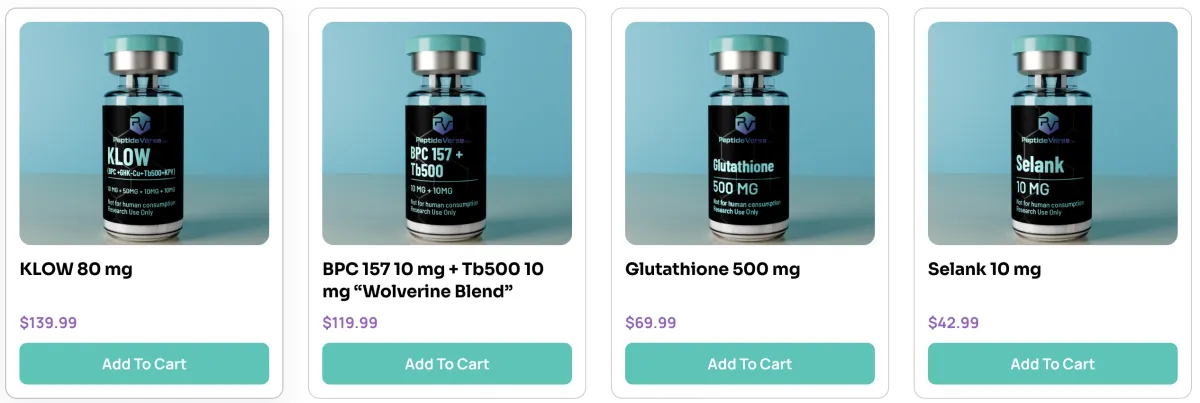 Open the full catalogue →
4The certificate library is the part competitors cannot copy quickly
Any site can write "lab tested" in a headline. It costs nothing and it means nothing.
Publishing a searchable index of third-party certificates costs something on every single batch, forever. Theirs is public: 15 certificates, 48 pages, filterable by product or by lot number, dated.
You can open it right now, before you spend anything, and read the analysis for a lot you have not bought yet.
A claim is free. A library that has to be fed on every batch is not.
15 certificates. 48 pages. Dated and searchable.
Third-party purity analysis for every lot they ship, published up front rather than sent on request.
Open the COA library →5Five things to check on any supplier before the first order
None of these need an email. All of them are on the site or they are not.
- A company name and a street address in the footer. If it is missing, stop there.
- A returns policy and a shipping policy as their own pages. Written commitments, not a paragraph in the FAQ.
- A certificate you can open before checkout, carrying a lot number and a test date.
- A named carrier and a domestic origin. "Ships worldwide, discreet packaging" is not a shipping method.
- Research Use Only stated at the door, on the labels and in the terms, consistently. Sites that say it in one place and contradict it in another have a bigger problem than shipping.
| When something goes wrong | Verse Research LLC | Anonymous overseas seller |
|---|---|---|
| Who you are contacting | Verse Research LLC, Sacramento CA | An inbox |
| Returns | Published refund policy | Case by case, if answered |
| Shipping | FedEx 2Day®, domestic | Border crossing, unnamed carrier |
| Proof for your batch | Lot-matched COA, public index | Product level PDF, or none |
| Compliance posture | 21+ gate and RUO terms at the door | Straight to the catalogue |
Buy from someone with an address.
Named US entity, domestic FedEx 2Day shipping, and a third-party certificate for every lot on the shelf.
Browse the lab-tested range →
Comments
Went and looked at the footers of the four suppliers I have used. Two have no company name at all. I had never once thought to check.
Did the same. One had an address that turns out to be a mail forwarding service. Technically an address.
Lost a parcel to customs in March. No entity to contact, no policy page, the reply was three words. That was the last overseas order I placed.
The point about the age gate costing them conversions is a good one. I had read it as an annoyance rather than a signal.
Agreed. Anything that reduces sales and is there anyway usually tells you something real.
The five point list is the useful part. Took me about four minutes across three sites and two of them failed on the first item.