Research Sourcing
Two Vials. Same Shelf. The Label Answers It Before The Forums Do.
Every thread on this argues the wrong thing. Five fields decide which listing you can actually trust, all five are printed, and not one of them needs an opinion.
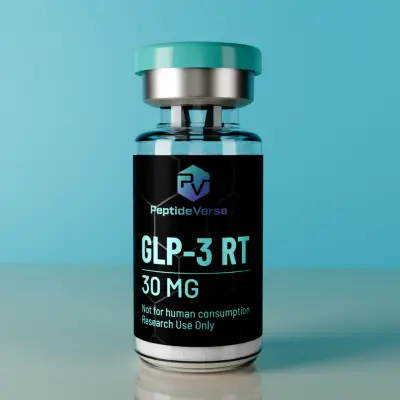 See it in the catalogue →
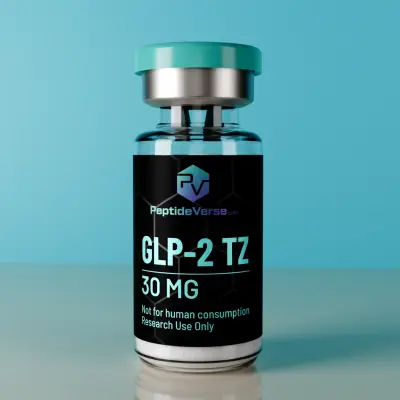 See it in the catalogue →
Both labels print the same six words: not for human consumption, research use only.
Search either of these and you land in a thread. Forty replies, four anecdotes, nobody citing a document.
Meanwhile every question you can actually answer is sitting on the product page.
A registry number is an identity. It is the public reference for one specific molecule. If a listing does not print one, the listing has not told you what is in the vial. Both of these print theirs.
A stated research context describes what the material is characterised against in model systems, and where that work stops. Both of these keep it inside cell-culture and animal-model work and say so on the page. A listing that drifts past that line has told you something about its compliance, not its chemistry.
Here is every verifiable line, side by side.
Both listings print the registry number. Both lots have a certificate.
Compare the two pages yourself rather than the two threads.
Browse the lab-tested range →1A name is not an identity
Product names in this space are house codes. Two suppliers can print the same short name on two different molecules, and neither of them is lying, because the name was never a specification.
A registry number is. It resolves to one structure. It is the single field that lets you check a supplier's vial against a public reference instead of against their marketing.
Both listings in the photographs print one. Look it up. The listing has to survive that lookup.
If a listing prints a name and no registry number, you have a nickname, not an identification.
2The thing the forums argue about is a structural difference, not a ranking
Threads treat this as better versus worse. The listings treat it as two different characterisation profiles, which is what it is.
Both pages say the same thing about where that work comes from and where it stops: model systems only.
Which one belongs in a given protocol is a question for whoever wrote the protocol. It is not a question a product page can answer, and any supplier who answers it for you has told you something about their compliance, not about their chemistry.
A supplier who will tell you which one to pick is a supplier who will tell you anything.
3Sizes decide your unit cost, and they are not symmetrical
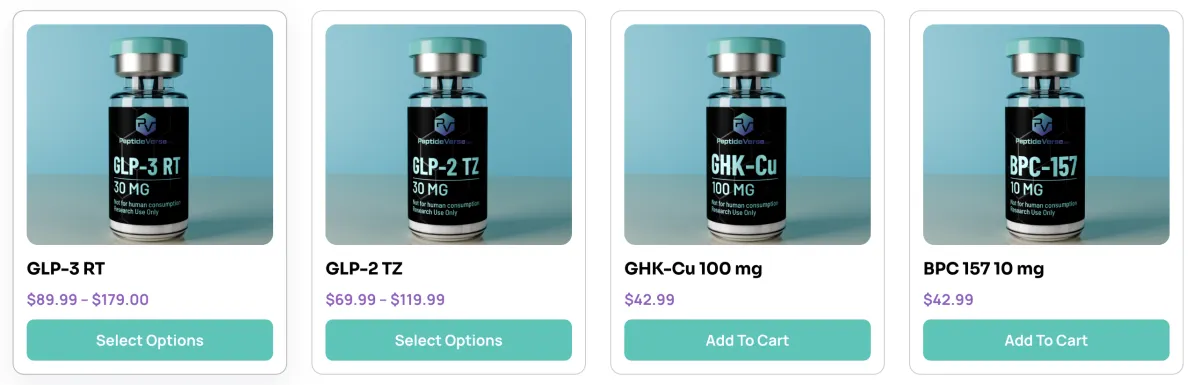
The first ships in 10 mg, 20 mg and 30 mg. The second ships in 15 mg and 30 mg. That is not a detail, it is the whole cost structure.
At the listed prices today, the first runs $9.00 per mg at its smallest size and $5.97 per mg at its largest. The second runs $4.67 per mg and $4.00 per mg.
Compare the vials and you learn nothing. Compare the milligrams and the two catalogues separate immediately.
Divide the price by the milligrams before you compare anything. It is ten seconds of arithmetic.
 Open the full catalogue →
4The fifth field is the one that decides it
Identity, context and size are printed by the supplier. They are claims. Good claims, specific claims, but claims.
The certificate is the only line on the page that was written by somebody other than the seller.
This advertiser publishes a public COA index: 15 certificates, 48 pages, filterable by product or lot number. The first item appears twice, at its smallest and largest sizes, both tested 17 June 2026. The second appears once, same test date.
You can open all three before you spend anything.
Four printed claims and one independent document. Read the document first.
15 certificates. 48 pages. Filter by lot number.
Third-party analysis for every lot they ship, published before you order rather than emailed after.
Open the COA library →5Five fields, one minute, any supplier
Run this on the next listing you open, whoever it belongs to.
- A registry number on the listing. Not in a PDF, not on request. On the page.
- Milligrams in the product name or the size selector. Otherwise you cannot price it.
- A stated research context that stays inside model systems and does not drift into what it does to people.
- A certificate carrying a lot number, reachable before checkout.
- A test date. A certificate with no date describes an unknown batch at an unknown time.
| Field | Item on the left | Item on the right |
|---|---|---|
| Registry number on listing | Printed | Printed |
| Research context bounded to model systems | Stated | Stated |
| Sizes | 10, 20, 30 mg | 15, 30 mg |
| Lowest listed cost per mg | $5.97 at 30 mg | $4.00 at 30 mg |
| Lots in the public COA index | Two | One |
Pick on the printed fields. Not the thread.
Both listings carry a registry number, a size ladder and a lot-matched third-party certificate.
Browse the lab-tested range →
Comments
The registry number point is the one nobody makes. I have three listings open right now from other suppliers and not one of them prints a reference number anywhere on the page.
Asked one of mine for it by email. Got a reply saying it was proprietary, which is not a thing a public registry number can be.
Appreciate that this stayed on what is printed instead of telling me which one to buy. Every other page I opened this week did the opposite.
Checked the lots referenced here against the index. Both there, both dated. That is the first time a page has given me something I could actually go and verify.
Same. The test date field matters more than people realise, a certificate with no date is describing nothing in particular.
The size ladder difference caught me out. Assumed both came in the same sizes and built a whole comparison on it.